
Table of Contents
- What Does 'Future Value of an Annuity' Mean?
- The Future Value of an Annuity Formula
- How to Calculate the Future Value of an Annuity — Step-by-Step Example
- Skip the Math: Use a Future Value of Annuity Calculator
- Putting Future Value to Work in Your Retirement Plan
- Frequently Asked Questions About the Future Value of an Annuity
Updated: July 23, 2026
What Is the Future Value of an Annuity?
For those not in the financial world, the concept of an annuity is confusing, so trying to calculate future value based on projections feels even more. The future value of an annuity is the total amount a series of regular payments will be worth at a specific point in the future, assuming a fixed interest rate.
If you’re planning for retirement, understanding this figure helps you estimate your future accumulation and shape your long-term financial roadmap. This guide breaks down the future value of an annuity formula, defines the core variables, provides a step-by-step example, and shows you how to use a future value annuity calculator to easily project your growth.
What Does 'Future Value of an Annuity' Mean?
To understand how annuities work, it helps to see how your money builds over time. Think of the Future Value (FV) of an annuity as watching your savings compound year after year. Every time you make a payment, that money earns interest, which then earns more interest.
This concept looks forward, making it fundamentally different from the Present Value (PV) of an annuity—which calculates the current worth of a stream of future payments. Knowing the future value allows you to see the estimated size of your nest egg before you begin drawing income.
The Future Value of an Annuity Formula
To find your projected balance using the FV of annuity formula, you use the future value of annuity equation. There are two variations based on when your periodic payments occur.
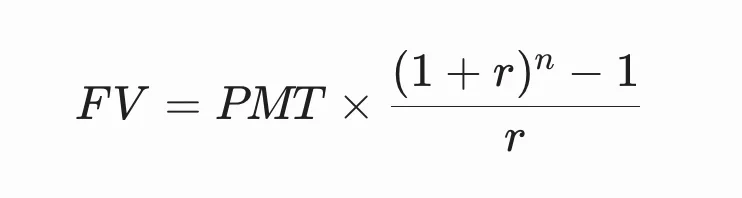
For an ordinary annuity (payments made at the end of each period), the FV annuity formula is:
For an annuity due (payments made at the beginning of each period), the calculation accounts for an extra compounding period:

Here is what each variable represents in the annuity future value formula:
|
Variable |
Description |
|
FV |
Future Value (the total accumulated amount you want to find) |
|
PMT |
Payment amount per period |
|
r |
Interest rate per period (annual rate divided by number of compounding periods) |
|
n |
Total number of payments over the entire timeline |
Most retirement plans, including deferred annuities, use the ordinary annuity structure where interest accumulates before payouts begin.
Ordinary Annuity vs. Annuity Due: Which Formula Should You Use?
When deciding how to calculate the future value of annuity balances, timing is everything. An ordinary annuity assumes payments happen at the end of a period, like with a monthly savings contribution. An annuity due assumes payments happen at the beginning, like a regular rental payment. Because an annuity due allows each payment to compound for one additional period, its final total will be slightly higher. Because of this, most consumer retirement products default to the future value of an ordinary annuity formula.
How to Calculate the Future Value of an Annuity — Step-by-Step Example
Let’s look at a practical example using the future value of an ordinary annuity formula over a 20-year retirement planning timeline.
Suppose you contribute $500 every month into an ordinary annuity based on a fixed rate of 4.8895% annually, compounded monthly.
- Monthly Payment (PMT): $500
- Monthly Interest Rate/APR (r): 4.8895% / 12 = 0.40741%
- Total Payments (n): 20 years x 12 months = 240 payments
Plugging this into the future value of ordinary annuity math:
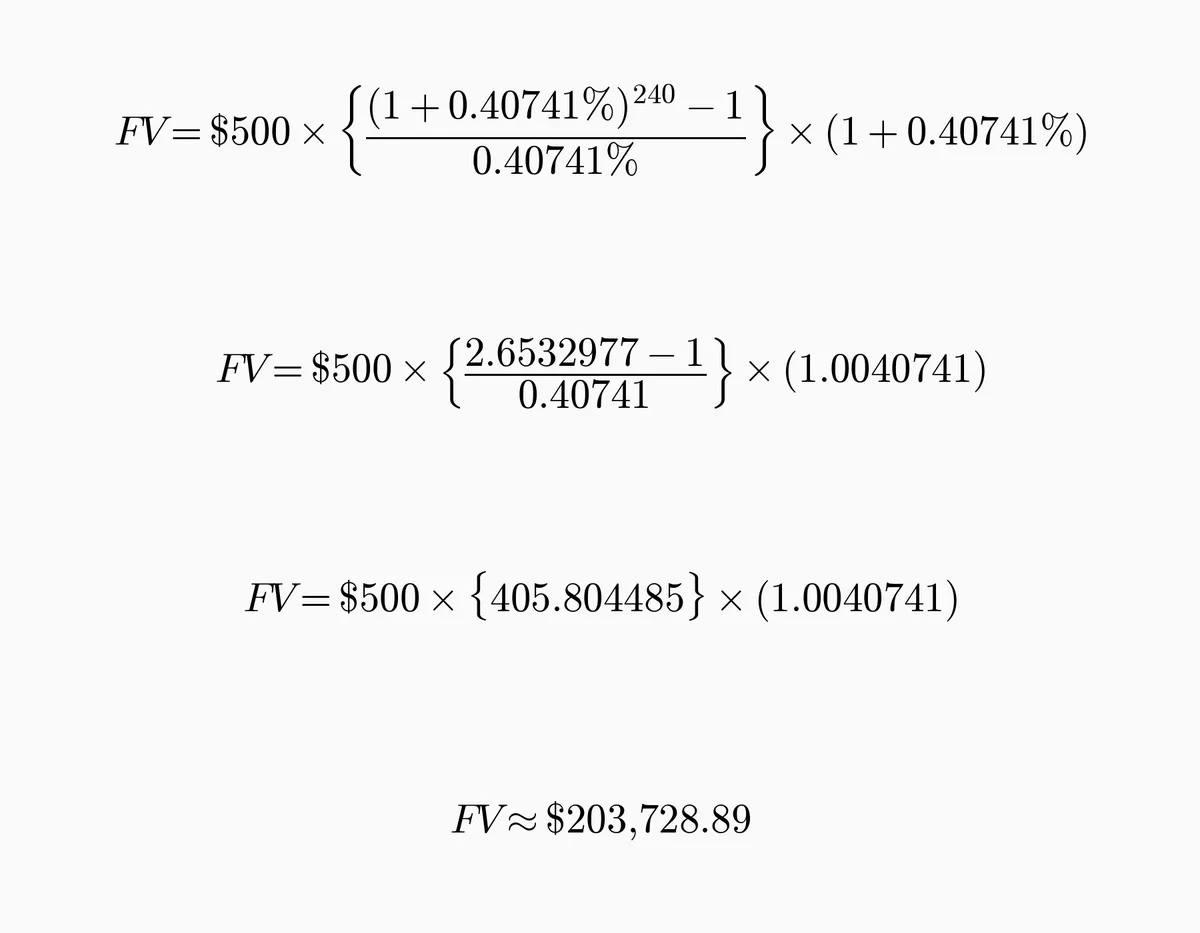
After 20 years, your annuity would have an estimated value of $203,728.89.
If you used an annuity due calculator approach—meaning you made your $500 payments at the start of each month instead of the end—the total would compound to approximately $206,373.
Skip the Math: Use a Future Value of Annuity Calculator
While knowing this formula provides helpful financial insight, manually calculating equations across multiple scenarios can be tedious. For real-world retirement planning, an interactive tool is faster, less confusing, and helps eliminate inevitable human error.
To instantly evaluate different timelines, you can calculate the future value of an annuity using the online Canvas Annuity Calculator. You simply input your periodic contributions and your estimated growth timeline to generate an instant projection. Shifting variables like your payment size or timeline helps you visualize how subtle adjustments modify your total estimated nest egg.
Putting Future Value to Work in Your Retirement Plan
Incorporating future value calculations into your strategy will help you set precise savings targets and evaluate the role of compound interest. Rather than guessing your numbers, analyzing the future value lets you see exactly how timeline choices influence your growth.
This knowledge makes it much easier to compare options, review historical annuity returns, and weigh current fixed annuity rates against other retirement vehicles. Ultimately, looking at these estimations shifts your focus to the variables you can directly control: how much you save, and how long you allow those funds to compound.
Frequently Asked Questions About the Future Value of an Annuity
What is the formula for the future value of an annuity?
The standard future value of an annuity formula is FV = PMT x [(1 + r)^n - 1] / r. In plain words, Future Value equals the periodic payment amount multiplied by the compound interest factor. In this equation, r represents the interest rate per period and n represents the total number of payments.
What is the difference between an ordinary annuity and an annuity due?
An ordinary annuity schedules payments at the end of each period, while an annuity due schedules them at the beginning. An annuity due yields a higher future value because every payment has one extra period to compound and earn interest.
How does interest rate affect the future value of an annuity?
The interest rate has a compounding effect on your money; higher rates lead to a significantly larger future value over time. Reviewing competitive fixed annuity rates helps to maximize the efficiency of your periodic payments, causing your estimated balance to build faster.
Can I use a calculator instead of the future value annuity formula?
Yes. While the manual future value of an ordinary annuity formula explains the foundational math, a dedicated future value annuity calculator handles complex compounding schedules seamlessly and lets you compare multiple scenarios in seconds.
What is the future value of an annuity due formula?
The future value of annuity due formula is FV = PMT x [((1 + r)^n - 1) / r] x (1 + r). It multiplies the standard ordinary annuity calculation by (1 + r) to account for the additional compounding period gained from beginning-of-period payments.
Ready to see what your annuity could be worth? Use our online Canvas Annuity Calculator to get a personalized projection in minutes.
Disclaimer: This calculator provides estimates only. Consult a licensed financial professional before making retirement decisions.





Resource Hub