
Updated: March 7, 2024
Self-Directed Annuities: Can You Really Build Your Own Annuity?
A self-directed annuity isn't actually a traditional annuity. It is an annuity that is held as part of a self-directed individual retirement account, or SDIRA.
This is a type of retirement account where the owner manages a broad selection of investments within the account prior to retirement and decides when and how money is distributed from the account in retirement.
Here’s what you should know about these types of accounts before you try to build your own annuity.
What is a Self-Directed Annuity?
A self-directed annuity is part of a vehicle known as a self-directed individual retirement account (SDIRA). This type of self-managed account allows you to choose the investments within the account based on your risk tolerance and growth goals.
These investments are typically broader than traditional vehicles like stocks, bonds, and mutual funds and can include "out-of-the-box" choices like real estate and precious metals.
Since you need to choose a custodian before you invest, your choices may be limited to those available in the custodian's portfolio. According to the Internal Revenue Service, the custodian is "a bank, a federally insured credit union, a savings and loan association, or an entity approved by the IRS to act as trustee or custodian."
While your investments are held and administered by the custodian, the custodian does not provide advice. They also do not evaluate whether an investment you choose is suitable or whether it complies with the applicable tax laws.
You are responsible for these decisions.
Traditional Annuities
Traditional annuities are offered and managed by life insurance companies. These companies offer multiple types of annuities based on your risk tolerance and goals (accumulation or distribution of money, for instance).
The insurance company is responsible for managing and administering the annuity.
That means once you have selected your annuity type and chosen the investment options, where available, you don't have to actively manage the investments within the annuity. The only exceptions might be to tweak investment allocations (for fixed-indexed and variable annuities) offered by the insurance company.
You can own an SDIRA without an annuity component and simply purchase the annuity directly from an annuity company. These products would sit outside of the SDIRA and are managed by the insurance company.
How Do Self-Directed Annuities Work?
When choosing a self-directed annuity, there are a handful of steps you need to take to execute the purchase:
- Identify and choose a reputable financial institution or custodian that offers Self-Directed IRAs. Not all custodians allow for self-directed investments, so it's crucial to select one that provides the flexibility you're seeking.
- Open a Self-Directed IRA account. This includes identifying beneficiaries and agreeing to the terms and conditions of the account.
- Transfer funds from an existing IRA or rollover funds from a 401(k) or other eligible retirement account into your new Self-Directed IRA. Ensure that the transfer is done in a way that avoids taxes and penalties.
- Select the annuity product you wish to invest in that will be part of the investments in your SDIRA account. This might include fixed annuities, variable annuities, or other types of annuities. Ensure that the annuity is eligible for purchase within a self-directed IRA.
- Thoroughly research and evaluate the annuity provider and the specific annuity product. Understand the terms, fees, surrender charges, and potential risks associated with the annuity.
- Once all paperwork is in order, the SDIRA custodian will facilitate the purchase of the annuity on behalf of the account. The funds from your SDIRA will be used to acquire the annuity.
- Regularly review the performance of your SDIRA and the annuity within it. Keep track of any required minimum distributions (RMDs) if you are of the age where they apply.
- Keep yourself informed about IRS rules and regulations related to SDIRAs. Failure to comply with these rules can result in penalties or disqualification of the SDIRA.
Typical investment vehicles within an SDIRA include:
- Real estate
- Annuities
- Commodities like gold, silver, oil and gas
- Cryptocurrency
- Private placements
- Land
Considerations When Considering a Own Self-Directed Annuity
As we mentioned, the term "self-directed annuity" might refer to an annuity held within a self-directed retirement account.
In this case, you could have more flexibility in choosing the specific type of annuity you want to invest in, such as a variable annuity, fixed annuity, or fixed-indexed annuity that sits within the SDIRA. Also, if your goal is to use part of your retirement assets to create a stream of income for life, then an annuity is the only product within the SDIRA that guarantees this capability.
SDIRAs might be an appropriate choice in your retirement portfolio if you are an experienced, savvy investor since this account requires the time and expertise to manage the underlying investments actively.
As we mentioned above, the first step in setting up an SDIRA is researching and then selecting a suitable custodian. All custodians of SDIRAs must be approved by the IRS. The first place to go is the IRS list of approved nonbank trustees and custodians.
Once you have some firms in mind, you may want to research the licensing and registration of potential custodians using SEC, Financial Industry Regulatory Authority, and state regulatory resources. The Better Business Bureau is also a good source. Additionally, the SEC recommends consulting a financial advisor or lawyer. These resources will give you an objective opinion and may know about the reputation of certain custodians.
Advantages of Self-Directed Annuities
Including annuities as part of your SDIRA can provide a handful of key advantages:
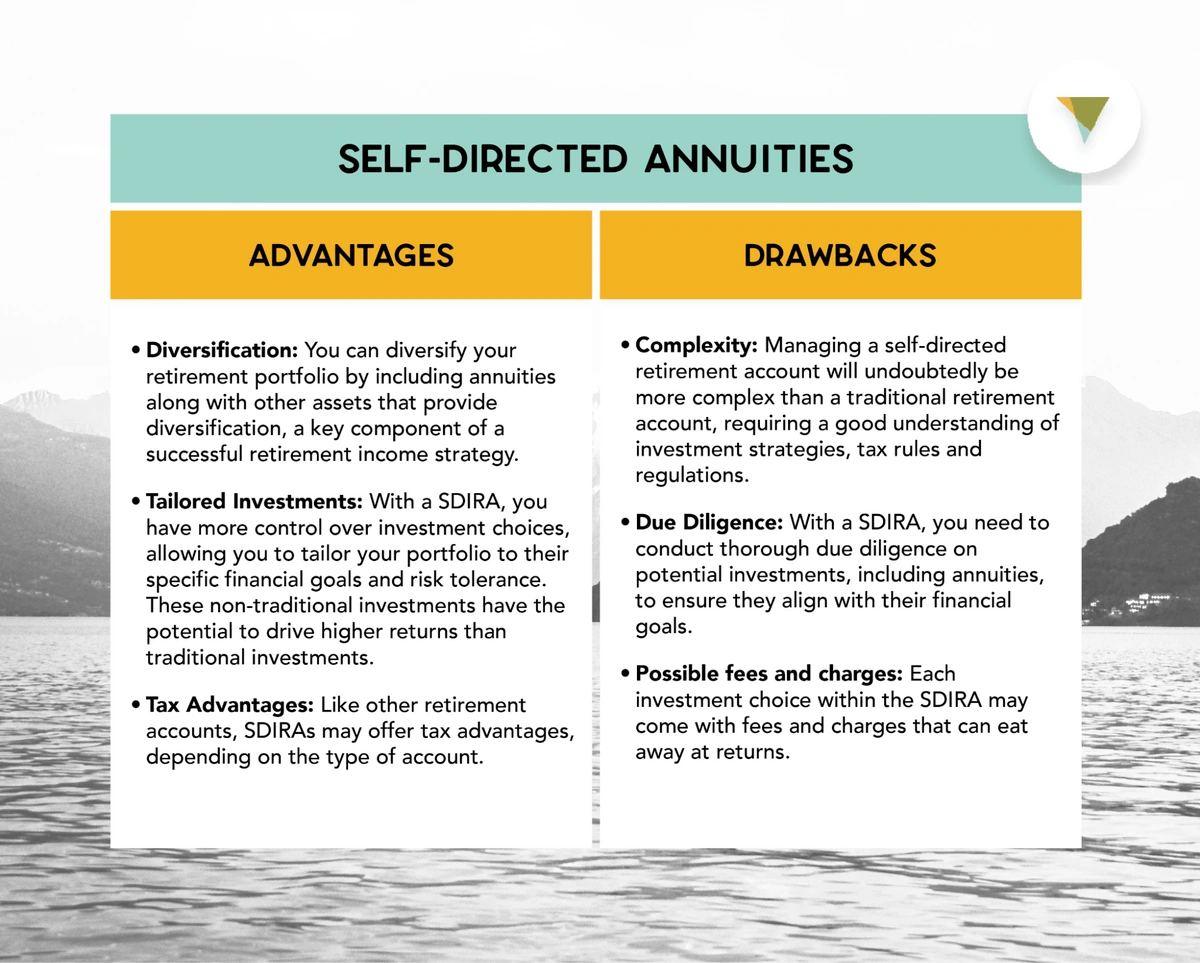
- Diversification: You can diversify your retirement portfolio by including annuities along with other assets that provide diversification, a key component of a successful retirement income strategy.
- Tailored Investments: With an SDIRA, you have more control over investment choices, allowing you to tailor your portfolio to their specific financial goals and risk tolerance. These non-traditional investments have the potential to drive higher returns than traditional investments.
- Tax Advantages: Like other retirement accounts, SDIRAs may offer tax advantages, depending on the type of account.
Disadvantages and Risks
SDIRAs also come with special considerations and disadvantages:
- Complexity: Managing a self-directed retirement account will undoubtedly be more complex than a traditional retirement account, requiring a good understanding of investment strategies, tax rules, and regulations. When buying an annuity directly from an insurance company, the insurer manages this complexity on your behalf.
- Due Diligence: With an SDIRA, you need to conduct thorough due diligence on potential investments, including annuities, to ensure they align with their financial goals. This requires time and research and at least a basic understanding of the benefits and drawbacks of underlying investments.
- Possible fees and charges: Each investment choice within the SDIRA may come with fees and charges that can eat away at returns. Make sure you understand these expenses before choosing the investment as part of the account.
Should You Build Your Own Annuity?
Creating an SDIRA can be complex and takes time, expertise, patience, and a tolerance for risk to manage this unique investment vehicle effectively. Add to that the tax liability that must be managed by you, not an administrator, and it can be a lot to consider.
But if this strategy is attractive to you as an experienced investor, go for it!
However, if you prefer to have some input into investment decisions but would rather not spend most of your time actively managing and administering these investments, then you may want to consider purchasing an annuity directly from an insurance company as part of a diversified investment portfolio. The good news is that these companies typically offer a broad selection of annuity products that can fill the needs of almost any investor, conservative or aggressive.
Remember that one of the key benefits of annuities is the ability to provide guaranteed income for life. That's why many people choose annuities to grow and distribute money as part of a well-diversified retirement plan.
Final Thoughts

Self-directed annuities placed within an SDIRA can be an effective tool for experienced investors who have the time and knowledge to actively manage these types of flexible accounts. SDIRAs provide investors with very broad, but also possibly risky, investment options.
Annuities purchased directly from an agent, or, in the case of Canvas annuities, directly from the company, can provide competitive returns as part of a diversified retirement portfolio. And the insurance company manages all of the administrative tasks so you don't have to. Annuities help you accumulate money prior to retirement and can guarantee income that you cannot outlive once retired.
Canvas annuities are fixed products offering very competitive guaranteed rates that are not impacted by swings in the financial markets. And you can purchase a Canvas annuity directly from the company over the phone or on the Canvas website.





Resource Hub