
Updated: March 7, 2024
What is a Declared Rate Annuity? How Do They Work?
A declared rate annuity, also called a fixed annuity, is an annuity that has a fixed interest rate declared for a specified period of time. It’s popular because it is a safe way to grow your retirement income. Later, you can convert it into a steady stream of retirement income.
Declared rate annuities are built for the risk-averse. The guarantee that your money will grow at the declared rate of interest acts as a built-in safety feature.
Wondering what a declared rate annuity is and whether it’s right for you? This article explains how it works, describes the pros and cons, and answers some common questions about declared rate annuities.
How Do Declared Rate Annuities Work?
A declared rate annuity is a type of insurance product designed to provide a guaranteed return over a specified period of time.
Here's how it typically works:
Purchase. First, you buy the annuity by paying premiums to an insurance or annuity company. This can be done as a lump-sum payment (single-premium) or through a series of payments over time (flexible premiums). The funds go into your annuity account.
Accumulation phase. The money in your account grows over a term you select—for example, three years, five years, or seven years. The insurance company will declare the fixed interest crediting rate that your money earns.
Annuitization and annuity phase. When you’re ready, you can choose to annuitize your annuity. That converts your fund into a steady stream of income.
Annuity withdrawal. If you don’t want to annuitize, you don’t have to. You can also simply withdraw your money at the end of the annuity term, or you can roll it over into another annuity.
Note that most declared annuities specify rules for withdrawal. Early withdrawals can result in tax penalties from the IRS or surrender charges if you withdraw your money within the surrender period.
Declared Rate Annuities vs. Other Annuity Types
Annuities come in various forms, and declared annuities (fixed annuities) are just one type. Each annuity type has its own set of features, benefits, and drawbacks.
Here’s how they stack up:
Fixed-Indexed annuities. A fixed-indexed annuity offers a guaranteed minimum rate of return (often 0%) along with the potential for additional earnings based on the performance of a market index, such as the S&P 500. Fixed-indexed annuities are somewhat riskier than declared annuities because they introduce market risk.
Variable annuities. A variable annuity provides a rate of return that varies based on the performance of underlying investments chosen by the holder. It’s higher risk because of market exposure, but can offer potentially higher returns.
Deferred annuities. A deferred annuity allows for your funds to accumulate over a term, with payouts beginning at a future date. Declared annuities are just deferred annuities with declared fixed interest rates.
Immediate annuities. Immediate annuities begin to pay you back a guaranteed stream of income that starts immediately or soon after you buy it. Immediate annuities usually don’t grow your money the way that declared annuities can because they don’t give you time to accumulate your money.
Each type of annuity could be appropriate for you—it depends on your circumstances and goals.
If you’re not sure, consider talking to a financial advisor to get more information about your options.
Pros and Cons of Declared Rate Annuities
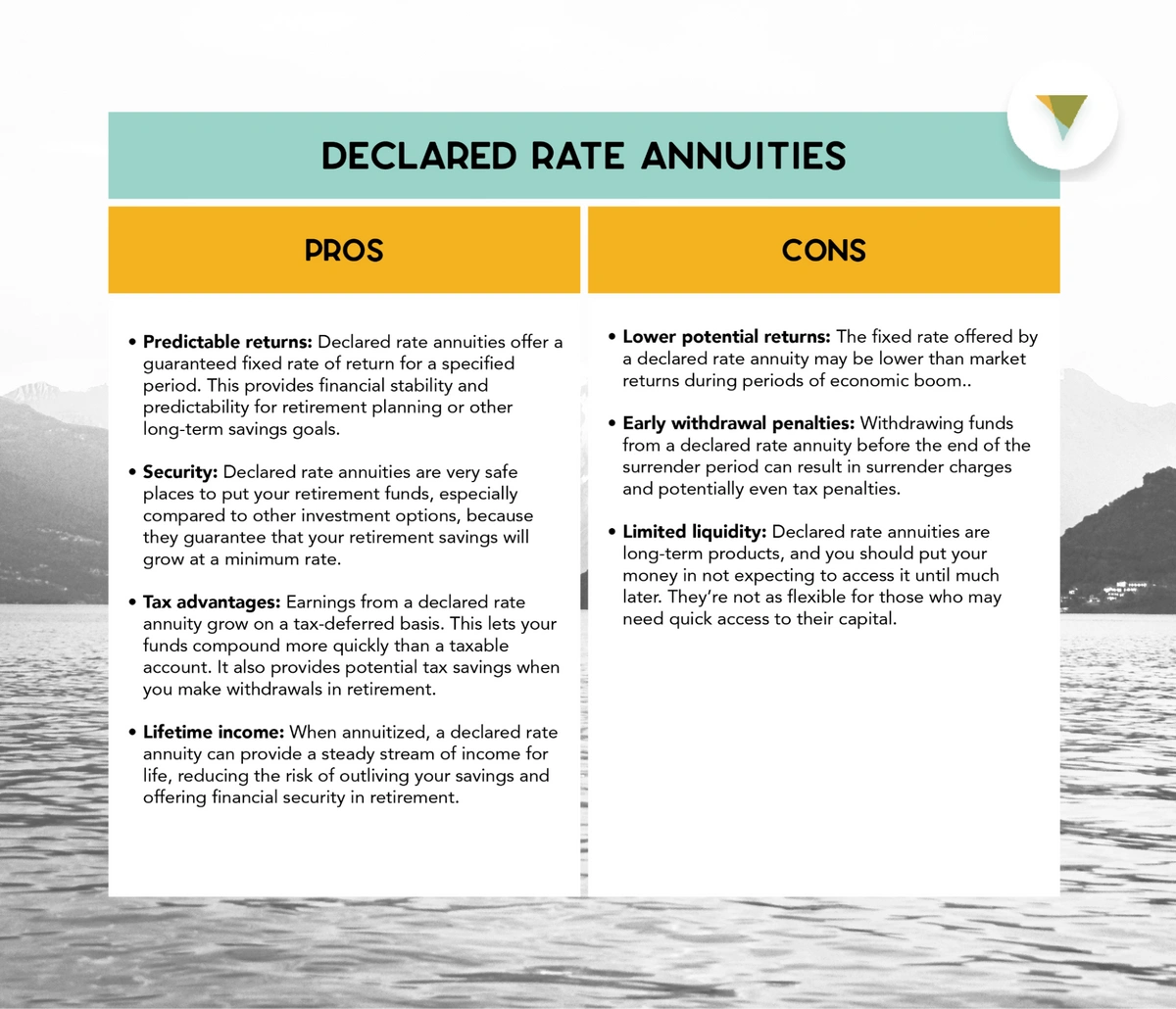
Declared rate annuities have some powerful advantages but also some drawbacks that you should consider.
Pros
Declared rate annuities are popular among retirees because they can be a powerful way to grow your retirement savings. Here are the advantages of declared rate annuities.
- Predictable returns. Declared rate annuities offer a guaranteed fixed rate of return for a specified period. This provides financial stability and predictability for retirement planning or other long-term savings goals.
- Security. Declared rate annuities are very safe places to put your retirement funds, especially compared to other investment options like stocks or mutual funds. That’s because they guarantee that your retirement savings will grow at a minimum rate. Usually, those declared rates are fairly high, too.
- Tax advantages. Earnings from a declared rate annuity grow on a tax-deferred basis. This lets your funds compound more quickly than a taxable account. It also provides potential tax savings when you make withdrawals in retirement.
- Lifetime income. This is maybe the biggest benefit: When annuitized, a declared rate annuity can provide a steady stream of income for life, reducing the risk of outliving your savings and offering financial security in retirement.
Cons
While declared rate annuities offer several benefits, they also come with certain drawbacks that should be carefully considered.
- Lower potential returns. The fixed rate offered by a declared rate annuity may be lower than market returns during periods of economic boom. You could miss an opportunity for greater growth.
- Early withdrawal penalties. Withdrawing funds from a declared rate annuity before the end of the surrender period can result in surrender charges and potentially even tax penalties.
- Limited liquidity. Declared rate annuities are long-term products, and you should put your money in not expecting to access it until much later. While you can get your money back if you need to, they’re not as flexible for those who may need quick access to their capital.
These disadvantages can be mitigated by making sure you get the right product for your financial circumstances. If you’re looking for a long-term place to safely and steadily grow your nest egg, a declared rate annuity could be for you.
Common Questions About Declared Rate Annuities
Considering a declared rate annuity as part of your financial strategy? Here are some of the questions you might have to help you make an informed decision.
Can the Rate Change After the Guarantee Period?
Yes, in a declared rate annuity, the interest rate is guaranteed only for a specific period.
That period often ranges from one to several years. Once this guarantee period expires, the insurance company will set a new interest rate for the next period. This new rate could be higher or lower.
It's important to carefully read the terms of your annuity contract and consult with a financial advisor to understand how the rate may change after the initial guarantee period.
Can I Access My Money During the Guarantee Period?
In most declared rate annuities, you can access a portion of your money during the guarantee period, but there are usually limitations and potential penalties.
Here are some common terms you might encounter:
- Free withdrawal clause. Some annuity contracts allow for a limited percentage of the account value to be withdrawn each year without incurring surrender charges—often around 10%.
- Surrender charges. If you withdraw more than the allowed percentage, you will likely face a surrender charge, which can be a significant percentage of the amount withdrawn.
- IRS penalties. If you are under 59½ years old, you may also be subject to a 10% early withdrawal penalty from the IRS in addition to ordinary income tax on the gains.
- Impact on future payouts. Note that early withdrawals may also affect the future value of the annuity and its income-generating potential. In other words, if you take money out of your annuity, it may not provide as much income in the future.
Make sure you consult your contract to understand the rules and penalties associated with early withdrawals from your declared rate annuity.
How Does Inflation Impact the Value of My Declared Rate Annuity?
Inflation happens when prices rise and you end up paying more for the same goods and services. That can have a significant impact on the real value—the purchasing power—of the fixed payments from a declared rate annuity.
Over time, even though you are earning money, that money may not be able to buy as much as it once could.
Remember, though, that the nominal value of your annuity funds still grows with a declared annuity.
In other words, the actual number of dollars in your annuity account will continue to increase at the declared interest rate. That happens regardless of whether there’s inflation or not.
Are There Any Fees Associated with Declared Rate Annuities?
There can be—it depends on your life insurance company.
Typically, the fee structure for declared rate annuities is simpler than for other types of annuities. But there are still some costs and charges to be aware of:
- Administrative fees. Some declared rate annuities might have annual administrative fees, although these are less common for this type of annuity compared to others.
- Commissions. While not a direct fee paid by the annuity owner, insurance agents and brokers typically earn a commission on annuity products, which is built into the pricing.
- Rider costs. Optional riders like enhanced death benefits or income guarantees can come with additional annual fees.
Note that Canvas Annuity products have zero commissions, account charges, or fees.
What Happens to My Declared Rate Annuity Upon My Passing?
It depends on the particular annuity contract, but usually, you get to choose.
Most annuities have optional death benefits. These ensure that any remaining annuity funds in your account are passed on to your children. Death benefits are built into Canvas Annuity’s products.
However, with some life insurance companies, death benefits are only available at an extra fee. Learn more about death benefits here.
Declared Annuities Can Help You Achieve Financial Security

Declared rate annuities are one of the many annuity products available to help you prepare yourself financially for retirement. Annuities can offer you a guaranteed income during retirement.
What’s special about declared rate annuities is that they offer you a period where your money grows at a steady, declared minimum interest rate.
It’s an extremely low-risk place to put your money because the interest rate is guaranteed.
That said, it’s not for everyone. If you’re looking for a short-term place to grow your money or want something higher risk, it might not be a good choice for you.
Still curious? Reach out to our licensed reps to ask any questions you still have. They’re knowledgeable and happy to help you understand more about whether a declared (fixed) annuity is right for you.





Resource Hub