
Updated: March 7, 2024
What You Need to Know About Annuities in Washington, D.C.
Washington, D.C. residents who are interested in purchasing annuities to enhance their retirement plans have many options. Annuities are for sale in Washington, D.C. via life insurance agents, financial advisors, and, in the case of Canvas Annuity, direct from the company.
When building your retirement plan, it is important to explore options based on your unique goals.
Whether you’re buying through an agent or directly from an annuity company, finding the right products is like assembling a puzzle—the pieces should fit together to provide you with maximum peace of mind.
While annuities for sale in The District have basically the same features and benefits as those available in other states, there are some unique attributes to consider.
A good place to start is with D.C.’s insurance regulator, The Department of Insurance, Securities and Banking (DISB). They provide a number of services, including agent and company look-up and even a guide to annuities.
But some of their guidance may be confusing for people new to annuities. That’s why we are providing more detail to give residents of Washington, D.C. a firm foundation to explore their options.
Introduction to Annuities in the District of Columbia
If you are buying from an insurance agent or financial advisor in Washington, D.C., it's good to know that the DISB licenses and regulates producers within the District of Columbia to protect consumers from unfair practices.
Here are a few of their most important rules:
- Individuals and agencies/firms may apply for a producer’s license either as a resident or non-resident applicant.
- Both resident and non-resident individuals and agencies may obtain authority in the areas of life, health, variable annuities, property, casualty, personal lines, and surplus lines.
- If an agent or agency are non-resident, they must be licensed and in good standing in their resident state and are licensed in Washington, D.C. through reciprocity.
There are more than 30 companies that offer annuities of all types (fixed, fixed-indexed, and variable, as well as deferred and immediate) in Washington, D.C.
Washington, D.C.’s Tax Treatment of Annuities

Each state treats annuities differently when it comes to taxes. Here’s what you should know about the way taxes on annuities work in the District of Columbia.
District Taxes on Retirement Income
Income from a pension, 401(k), IRA, or any other type of retirement account is taxable in The District at rates ranging from 4% to 10.75%.
Qualified annuities are included in this group of products because they are funded with money not yet taxed.
You are taxed on the entire amount of withdrawals when you take from them. Certain types of annuities, called non-qualified annuities, are purchased with money that you've already paid taxes on. Therefore, when you begin taking withdrawals from non-qualified annuities, you only pay taxes on the gains earned on the annuity contract.
Withdrawal Tax Treatment
Washington, D.C. does not assess any premium taxes and does not charge any additional punitive tax for early withdrawals from your annuity.
However, the issuing annuity company may charge surrender fees for early withdrawals. Also, the Internal Revenue Service (IRS) may assess a premature withdrawal penalty of 10% and charge income tax on the withdrawn funds.
The amount of the surrender charge depends on how long you stay in the contract. The penalty for early withdrawal depends on your age and the circumstances for making the withdrawal.
Annuity Laws and Regulations in Washington, D.C.
The focus of The Department of Insurance, Securities and Banking (DISB) is advocating for consumers of insurance and related products like annuities.
They are responsible for monitoring insurance companies’ financial stability and ensuring they follow the state's laws and treat consumers fairly. They offer guidance, support, and education for consumers and regulate the industry in a way that promotes fair competition and makes sure insurance is available to everyone in the District.
Agent Licensing Requirements
For an individual to sell life insurance and annuity products in Washington, D.C., they are required to take a pre-licensing course before taking the Producer Licensing Exam.
Once an agent passes the exam, they can apply for a producer's license. The application is received by a national producer registry known as the National Insurance Producer Registry (NIPR).
In order to renew their license, Washington D.C. requires agents to complete a one-time four (4) credit training course approved by the Department.
Buying an Annuity in Washington, D.C.
Like most Americans, people in The District generally buy annuities for two reasons:
- They want to grow money on a tax-deferred basis before retirement
- They want to create a guaranteed flow of income in retirement
Accumulation
The accumulation phase starts when you make an annuity purchase. It’s the period of time during which your annuity earns interest and grows prior to retirement. Annuities can be a valuable part of a retirement savings plan, especially fixed annuities, the most conservative type.
In this phase, the money in your account earns interest, and the interest crediting rate is determined by the type of annuity you have (explained below). Your money accumulates on a tax-deferred basis.
Some annuities, called immediate annuities, skip the accumulation phase. They start to pay you back immediately or soon after you pay your premiums.
Distribution/Annuitization
Your money continues to earn interest and grow until you annuitize it. When you annuitize, you end the accumulation period and start receiving regular income payouts. This is called the annuitization period or payout phase.
When you annuitize, you’ll choose between different payout options, like how often you want your income payouts, how long you want your income payments to last, and whether you want to add a joint annuitant.
For example, you might choose monthly payments for the rest of your life. Or, you might choose to receive monthly payments for a specified period, like 10 years. In the first option, each payout would be much lower than the payouts in the second option.
A financial professional can help you decide which type of annuity is best for your unique needs.
Steps to Consider When Buying an Annuity in The District

Before buying an annuity, there are a handful of things Washington, D.C. residents need to consider:
- The goal of the purchase: Accumulate money or create a stream of income.
- Your comfort with risk: Annuities come in a few varieties based on your appetite for risk. Fixed annuities are the most conservative type, followed by fixed-indexed and variable annuities.
- The financial strength of the issuing insurance company: The life insurance companies that issue annuities receive financial strength ratings from a few notable rating agencies, including A.M. Best, Fitch, and others. It's a good idea to research the company that is issuing your annuity and make sure they have a "good" rating from these agencies.
- Fees associated with the annuity: There are some annuity fees to be aware of, regardless of the type of annuity you are considering.
- Death benefit provisions: Most annuities feature a standard death benefit. This feature lets you pass on assets from the annuity heirs after your death. The feature may also appear as an optional annuity rider and may have a cost related to it.
Types of Annuities Available in Washington, D.C.
Most companies that have products available in The District can offer deferred and immediate annuities (for both the accumulation and distribution phase) as well as three general varieties based on your risk appetite:
Fixed annuities: Fixed annuities offer a fixed rate of return guaranteed by the insurance company for specific periods of time. People sometimes buy a fixed annuity to provide a solid foundation for their retirement plan since rates are locked in for the period of time you choose, usually 3, 5, or 7 years.
Fixed-indexed annuities: These products share features of fixed and variable annuities. Fixed-indexed annuities offer a guaranteed floor rate (usually 0% so you won’t lose money) and a rate "ceiling" as well. They offer more accumulation potential versus fixed annuities. You choose an investment “index” (like the S&P 500) which drives your returns.
Variable annuities: This is the most volatile type of annuity but also offers the largest accumulation "upside" because returns are linked to stock market funds that you choose. Unfortunately, they can be difficult to understand, have no "floor" (you can lose money), and usually have lots of management and other fees that the insurance company charges.
Washington, D.C. Fixed Annuity Rates
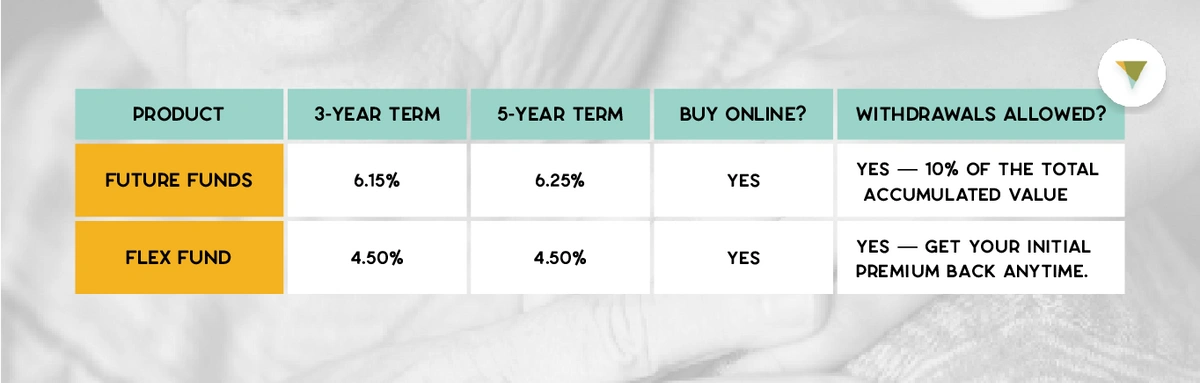
One of the most important factors when choosing an annuity is the interest rate. Higher interest rates mean your annuity account grows faster.
Here are the three-year and five-year rates for fixed annuity products offered by Canvas Annuity.
Final Thoughts
When buying an annuity in Washington, D.C., you have a lot of choices. The best product to buy depends on what your goals are (accumulating money or creating a stream of income that you can't outlive), as well as your risk tolerance.
Fortunately for District residents, fixed annuities from Canvas Annuity are now available for sale. Canvas offers some of the most competitive fixed annuity rates in the country, and you can buy right over the phone or on your own from the company's website.s





Resource Hub