
Table of Contents
Updated: March 7, 2024
What is a Non-Qualified Annuity? Key Features, Benefits, and Potential Drawbacks
When you consider purchasing an annuity, and you fund that annuity with money that has already been taxed, you are buying a non-qualified annuity. This annuity differs from qualified annuities, which are funded with pre-tax dollars from IRAs and other retirement accounts.
The source of money used to buy an annuity is your first decision when adding an annuity to your pre- or post-retirement plan.
An annuity is a financial product offered by insurance companies that can help you accumulate money prior to retirement and then provide a stream of income to you over a specified period of time or for your lifetime. Annuities are the only financial product that guarantees income that you cannot outlive.
Non-qualified annuities are typically used for retirement planning to help you achieve your long-term financial goals. Here’s what you need to know about them.
Key Features of Non-Qualified Annuities
A non-qualified annuity is purchased with after-tax dollars.
This simply means that you have already paid taxes on your money before it goes into the annuity. Since you’ve already paid taxes before contributing the money into a non-qualified account, when you start to withdraw funds, the part on which you’ve already paid taxes will not be taxed again.
Only growth in the annuity will be taxed.
Buying an annuity with non-qualified money does not compete with your retirement plan at work or if you have a Traditional IRA or Roth IRA. It is another, less restrictive way to build retirement funds.
Like your 401(k) or traditional IRA, all the funds in a qualified annuity are tax-deferred. However, qualified accounts have contribution limits and come with additional restrictions governed by the Internal Revenue Code.
If you’ve already contributed your maximum pre-tax contributions on other retirement accounts like a 401(k), then you will only be allowed to purchase a non-qualified annuity.
Tax Implications and Benefits
Non-qualified annuities have distinct tax advantages over qualified annuities.
Because non-qualified annuities are purchased money that has already been taxed, only the earnings on your principal are taxable.
Most traditional investments require that you pay taxes on growth. Because non-qualified annuities do not require you to pay taxes until you begin withdrawing funds, you have more capital with which to grow.
Since these accounts are exempt from required minimum distribution rules that apply to qualified accounts, you have a longer time frame to grow your money. This allows you to begin receiving payments at any age.
Important rule: in most cases, any money withdrawn from an annuity before you turn 59 ½ will result in a 10% early withdrawal tax penalty.
Sources for non-qualified money can be savings accounts, checking accounts, CDs, money market accounts, etc.
Can I Buy Any Type of Annuity with Non-Qualified Money?

While different insurance companies may offer different types of annuities and the terms, features, and benefits of products can vary, you can typically buy any type of annuity with non-qualified funds. These include:
Immediate Annuities: These provide regular payments that start immediately after you purchase the annuity. They can offer a steady stream of income for a specified period or for the rest of your life.
Deferred Annuities: These allow your investment to grow tax-deferred until you start taking withdrawals. They can be either fixed (with a guaranteed interest rate), fixed-indexed (investments tied to an index like the S&P 500), or variable (investment options tied to stock market funds).
Fixed Annuities: These offer a guaranteed interest rate for a specific period of time. Your principal is protected and earns a fixed return.
Fixed-Indexed Annuities: These annuities provide returns linked to the performance of a specific market index, such as the S&P 500. They offer potential for higher returns than fixed annuities while still providing some level of principal protection.
Variable Annuities: These allow you to invest your money in a variety of investment options, similar to mutual funds. The value of your variable annuity will fluctuate based on the performance of the underlying investments, and you could lose money.
Longevity Annuities: Also known as deferred income annuities, these provide guaranteed income that starts at a future date, usually in advanced age. They are designed to provide a lifetime income stream and can be purchased with a lump sum.
Advantages of Non-Qualified Annuities
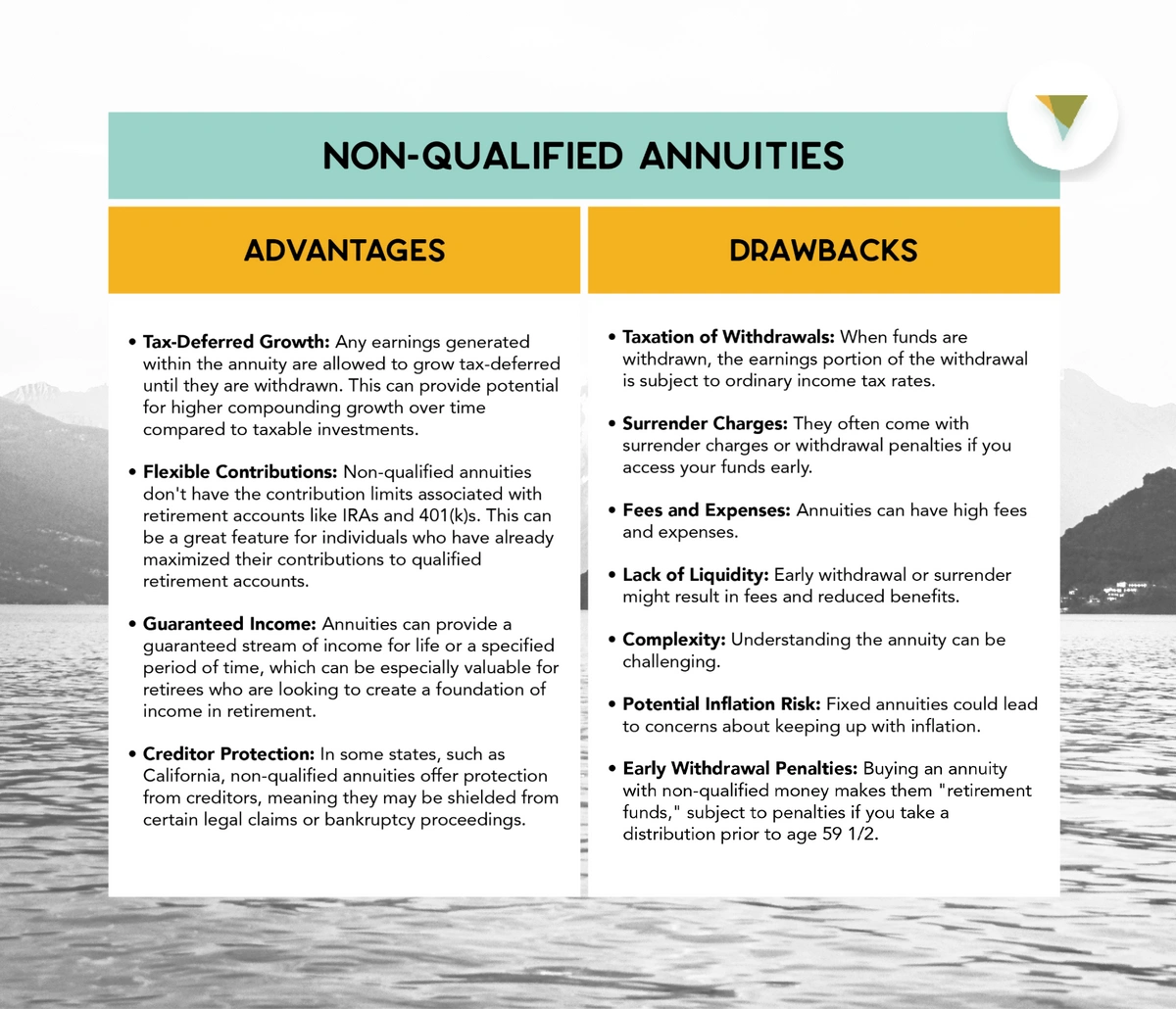
Non-qualified annuities have advantages and drawbacks. Let's review a few of the benefits.
Benefits of non-qualified annuities include:
Tax-Deferred Growth: While the initial investment in a non-qualified annuity is made with after-tax money, any earnings generated within the annuity are allowed to grow tax-deferred until they are withdrawn. This can provide potential for higher compounding growth over time compared to taxable investments.
Flexible Contributions: Non-qualified annuities don't have the contribution limits associated with retirement accounts like IRAs and 401(k)s. This can be a great feature for individuals who have already maximized their contributions to qualified retirement accounts.
Guaranteed Income: Annuities can provide a guaranteed stream of income for life or a specified period of time, which can be especially valuable for retirees who are looking to create a foundation of income in retirement.
Creditor Protection: In some states, such as California, non-qualified annuities offer protection from creditors, meaning they may be shielded from certain legal claims or bankruptcy proceedings.
Early Withdrawal Penalties: Buying an annuity with non-qualified money makes them "retirement funds," subject to penalties if you take a distribution prior to age 591/2.
Potential Drawbacks
Non-qualified annuities (and annuities in general) can also have drawbacks, most linked to the fact that annuities are long-term financial products.
Drawbacks of non-qualified annuities include:
Taxation of Withdrawals: When funds are withdrawn from a non-qualified annuity, the earnings portion of the withdrawal is subject to ordinary income tax rates. This is different from qualified retirement accounts, where withdrawals might have different tax treatment.
Surrender Charges: Non-qualified annuities often come with surrender charges or withdrawal penalties if you access your funds before a certain period, which can limit your liquidity.
Fees and Expenses: Annuities can have high fees and expenses, including administrative fees, mortality and expense fees, and investment management fees. These costs can eat into your overall returns.
Lack of Liquidity: Non-qualified annuities are intended to be long-term financial products. Withdrawing funds early or surrendering the annuity might result in substantial fees and reduced benefits.
Complexity: Annuities can be complex financial products, and understanding all the terms, features, and potential benefits or drawbacks can be challenging.
Potential Inflation Risk: Fixed annuities (as opposed to fixed-indexed or variable annuities) may not offer as much potential for growth as other investment options, and this could lead to concerns about keeping up with inflation over time.
Common Misconceptions about Non-Qualified Annuities
The term non-qualified simply refers to rules set by the Employer Retirement Income Security Act (ERISA) of 1974.
It created definitions for qualified and non-qualified retirement plans with the intent of protecting workers’ retirement income and providing information and transparency around the use of money in retirement.
A qualified retirement plan is one that meets ERISA guidelines, while a non-qualified plan does not.
It does not make it better or worse than a qualified annuity. It just features different rules regarding taxation. Some examples:
- Qualified plans include 401(k) plans, 403(b) profit-sharing plans, and IRA accounts.
- Non-qualified plans include money in checking, savings, CD, and money market accounts, as well as deferred compensation plans.
For more information, check out our guide comparing qualified and non-qualified annuities.
As we mentioned above, non-qualified annuities defer taxes due until you access the money. They are not tax-free. And the good news is that you only pay taxes on any gains since you would have already paid taxes on the principal invested.
Non-qualified annuities can be as safe or as risky as you choose, based on the annuity you choose (fixed, fixed-indexed, or variable).
When is a Non-Qualified Annuity Right for You?
Whether or not to use qualified money to buy an annuity depends on your individual goals and financial situation.
For instance, if you believe you will have enough income from qualified accounts (401(k)s, pensions, and IRAs) and are feeling the pressure to take required minimum distributions (RMDs) from these accounts, then buying a non-qualified annuity might be a good idea.
This is because, under IRS rules, you are not required to take RMDs from your non-qualified accounts, including annuities, at any time. This means that you can begin taking distributions from these accounts later in retirement.
When considering the type of money to use to buy an annuity, it is a good idea to talk with a licensed agent or financial advisor.
They can provide advice based on your personal financial situation and income needs in retirement. Different insurance companies have a variety of products and rates, so it's a good idea to shop around.
The good news is that when you are ready to buy an annuity, you don't necessarily need to meet with an agent face-to-face. There are companies like Canvas Annuity where you can get advice and conduct the entire buying transaction over the phone or online in minutes.
Final Thoughts

Remember that non-qualified annuities simply refer to ERISA rules. They have their own features and benefits, like qualified annuities. It's almost always a good idea to have a mix of products and risk profiles as part of a robust retirement portfolio. Annuities are unique in that they are the only financial product that can guarantee income for life.
Understanding the differences between products and the tax treatments around those products is important and worth the time to research. And when in doubt, reach out to a licensed professional for advice.
Canvas Annuity offers fixed annuity products that can accept both qualified and non-qualified money. And they feature some of the most competitive fixed annuity rates in the country! Check them out today!





Resource Hub