
Updated: November 7, 2025
How to Choose Between Annuities, 401(k)s, and IRAs for Retirement Savings

Saving for the Retirement You Want
When you plan for retirement, the smartest strategies are the ones that give you options. But that can be easier said than done. If you are wondering how annuities, 401(k)s, and Individual Retirement Accounts (IRAs) fit into your overall retirement savings, you are not alone.
In this article, we’ll break down the differences between 401(k)s, IRAs, and annuities, helping you choose the right mix based on your financial goals and when you plan to retire. See how IRAs vs annuities, 401(k)s vs annuities, and other savings strategies stack up so you can create a the best retirement savings investment plan for you.
What is a 401(k)?
A 401(k) is an employer-sponsored retirement savings account where you can contribute a portion of your pre-tax income (unless you have Roth 401(k) where contributions are made after tax). Contributions into a 401(k) account grow using a combination of stocks, bonds, mutual funds, and other investments.
Traditional 401(k)s are most common for workers in the private section. There are variants like the SIMPLE 401(k) for small business owners, 403(b) plans available to public school employees, nonprofits, and religious organizations and 401(a) plans available to government workers.
401(k) Benefits:
- Option for perks like employer matching contributions
- Compounding interest that grows funds over time
- Contributions are flexible and can be automated
- Money can be added tax deferred
401(k) Drawbacks:
- Market exposure introduces a level a risk
- Investment options are dependent on your employer’s plan
- You can be penalized if you withdraw money before age 59½
- Subject to required minimum distributions (RMDs) after age 73
What is an IRA?
An Individual Retirement Account, or IRA, is a tax-advantaged retirement account that is not tied to an employer. IRAs can be opened with financial institutions like banks, insurance companies, credit unions, or investment brokers. There are two main types of IRAs:
- Traditional IRA: Contributions are often tax-deductible, and earnings grow tax deferred. You pay taxes when you withdraw funds.
- Roth IRA: Contributions are made with after-tax dollars, but qualified withdrawals are tax free in retirement.
- Bonus: Comparable to the SIMPLE 401(k), there is also a SIMPLE IRA plan available for small business owners
IRA Benefits:
- More directly choose your account’s investments
- Contributions to traditional IRAs are tax-deductible
- Withdrawals from Roth IRAs are tax free
- Useful for those without access to employer-sponsored plans
IRA Drawbacks:
- Lower annual contribution limits compared to 401(k)s
- Income limits may reduce or eliminate Roth IRA eligibility
- Early withdrawal from a traditional IRA comes with a 10% tax penalty
- Market exposure can introduce a level of risk
What is an Annuity?
An annuity is a contract with an insurance company that provides regular payments in retirement, often for life. Annuities are designed to generate steady income, regardless of market conditions. Different types of annuities include:
· Immediate vs. Deferred: Immediate annuities start paying income right away, while deferred annuities allow your investment to grow first.
· Fixed vs. Indexed vs. Variable: Fixed annuities offer set interest rates. Indexed annuities tie earnings to a market index, and variable annuities depend on the performance of chosen investments.
Annuity Benefits:
- Options for guaranteed lifetime income
- Can protect you from outliving your savings
- Options for tax-deferred growth (for deferred annuities)
- No annual contribution limits
Annuity Drawbacks:
- Can be less liquid than other savings options
- Interest rates for fixed and variable annuities are exposed to market risk
- May involve fees or surrender charges
- Terms can sometimes be complex to understand
Choosing the Best Place to Put Retirement Savings
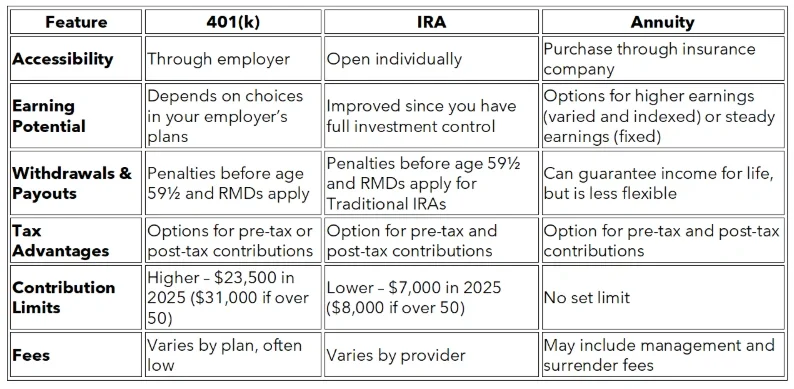
Deciding between a 401(k), IRA, or annuity isn’t about finding the single best solution. 401(k)s are foundation for many people’s retirement savings, bolstered by employer contributions. IRAs are great for filling gaps with carefully chosen investments. And
annuities can be the safety net you need to guarantee an income stream when you hit retirement. See how these savings options compare in the chart below.
Diversify How You Save for Retirement
Planning for retirement doesn’t mean going all in on just a 401(k), IRA, or annuity, many people benefit most from using a combination of all three. Diversifying your retirement savings investments can help you reduce risk, maximize tax benefits, and create multiple income streams in retirement.
To find the right balance for your personal goals, talking with a financial advisor can make a big difference. If you have questions about annuities specifically, the team at Canvas Annuity is here to help. We can walk you through how annuities work, their benefits, and how they can fit into your overall retirement plan.





Resource Hub